A Guide to Sanskrit Theatre
An encyclopedic walk through the texts, figures, and forms of classical Indian performance — drawn from the Nāṭyaśāstra and its long commentary tradition.
The Nāṭyaśāstra
नाट्यशास्त्र
The Nāṭyaśāstra is the foundational treatise on the performing arts in the Indian tradition. Tradition calls it the Nāṭyaveda — a "fifth Veda" given by Brahmā so that the truths of the older Vedas could be made available to all, through the senses, in delight.
It is at once a manual and a philosophy: it lays out the architecture of theatres, the proportions of stages, the classification of plays, the grammar of gesture, the structure of music, the typology of characters — and within all of this, the theory of rasa that gives the rest its purpose.
Bharata Muni
भरतमुनि
Bharata is more a tradition than a man. The name may refer to a single sage, a school, or a lineage of compilers; the text we have is plainly the work of more than one hand over more than one century. What matters is the figure the tradition preserved: an authoritative codifier, the first to write that performance is a science with rules — and a soul.
His mythic origin story has Brahmā composing the Nāṭyaveda from elements of the four Vedas: words from the Ṛg, song from the Sāma, gesture from the Yajur, and rasa from the Atharva. Bharata receives it and instructs his hundred sons in its performance.
Rasa Theory
रस सिद्धान्त
"Vibhāvānubhāva-vyabhicāri-saṃyogād rasa-niṣpattiḥ."
Rasa arises from the union of determinants, consequents, and transitory emotions. — Nāṭyaśāstra, 6.31
The word rasa means "juice," "essence," "taste." Bharata's metaphor is culinary: just as a master cook combines spices and ingredients so that the diner tastes a flavor that is in none of them alone, the playwright combines vibhāvas (situations and stimuli), anubhāvas (the actor's visible responses), and vyabhicāribhāvas (passing moods) so that the audience tastes a rasa that is in none of these alone.
The rasa lives in the audience, not in the actor or the script. This is the great inversion of the theory: the goal of performance is not to depict an emotion but to produce one — and the one it produces is more refined, more contemplative, than the raw feeling itself. The grief in the audience is not sorrow. It is karuṇa-rasa — sorrow as flavor, taken in beauty.
The Nine Rasas
नवरस
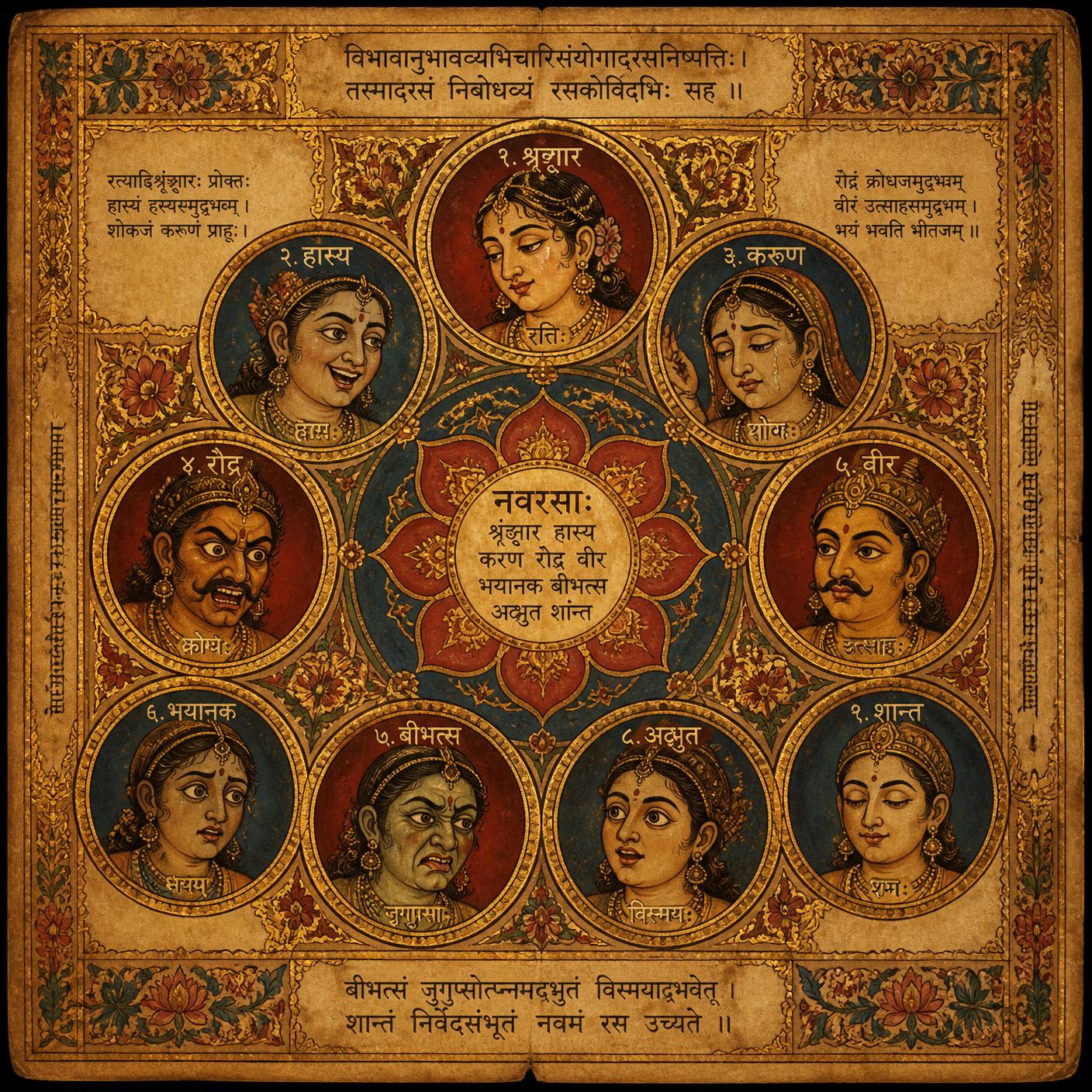
The sentiment of love, union, and beauty — held as the king of rasas in many treatises.
Laughter born of incongruity, the lightness that loosens the audience into receptivity.
Compassion and grief, the deep blue current beneath tragic separation and loss.
The hot, expanding sentiment of righteous fury — battle, vengeance, divine wrath.
The steady fire of resolve and noble striving, the breath of epics.
Terror — the cold contraction of the body before a threat seen or unseen.
The recoil from corruption, decay, the broken order of things.
Astonishment at the unexpected, the widening of the eyes before a marvel.
The ninth rasa, added later — the still water of liberation, where all sentiments dissolve.
Kālidāsa
कालिदास
If Bharata gave Sanskrit drama its theory, Kālidāsa gave it its summit. Active around the 4th–5th century CE, possibly at the court of Chandragupta II, he wrote three plays — Mālavikāgnimitram, Vikramorvaśīyam, and Abhijñānaśākuntalam — alongside two long poems and two epics.
The Śākuntalam, his masterwork, was the first Sanskrit play translated into a European language (William Jones, 1789), and its impact on Goethe and the German Romantics was electric. Goethe wrote a couplet in its honor: "Wouldst thou the young year's blossoms and the fruits of its decline / and all by which the soul is charmed, enraptured, feasted, fed... I name thee, O Śakuntalā, and all is said."
Love, loss, recognition.
A king pursues a nymph through marvels.
Court intrigue and a queen's jealousy.
Stage & Conventions
रङ्गपीठ
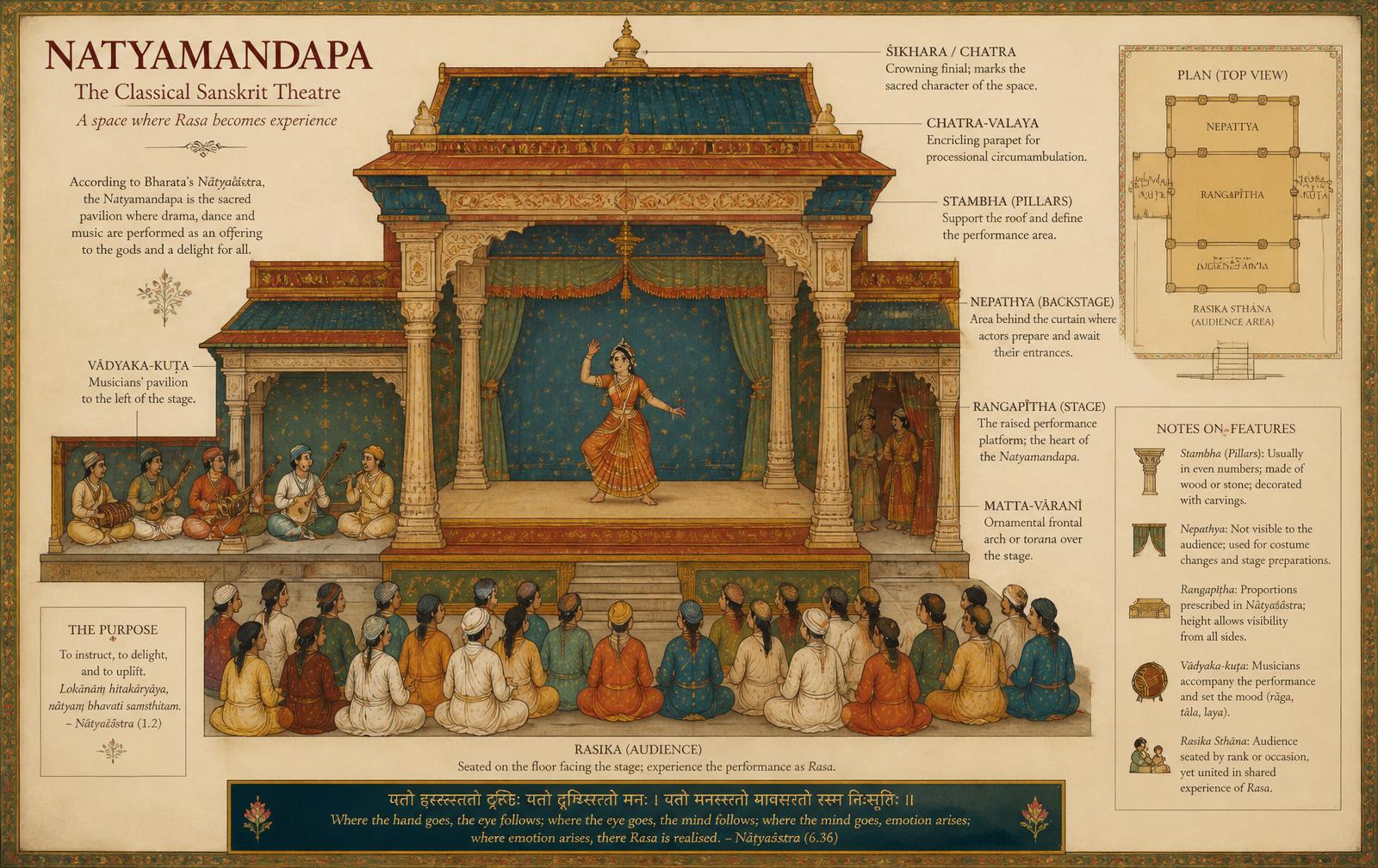
The Nāṭyaśāstra describes three shapes of theatre — square, rectangular, and triangular — and three sizes. The medium rectangular hall, 64 by 32 hastas, was considered ideal: large enough for an audience, small enough that the subtle play of an actor's eyebrow would reach the back row.
The stage was divided ritually. The rangapīṭha was the playing space; the nepathya behind it, the dressing room and place of preparation; the mattavāraṇī, an ornamental side platform. Before any performance, a pūrvaraṅga — a preliminary ritual of music, blessings, and invocations — consecrated the space.
- · No curtain divided audience from stage; the imagination did.
- · Time and place shifted by gesture and convention, not by scenery.
- · The Sūtradhāra (literally "thread-holder") opened every play, introducing the work to the audience.
- · Death and violence were never shown on stage; they were narrated, transmuted into rasa.
Music & Dance
सङ्गीत · नृत्य
Sanskrit theatre was never spoken alone. Music — vocal and instrumental — accompanied performance throughout, and the rāga system gave each scene its emotional ground. Drums (mṛdaṅga), strings (vīṇā), and the human voice were the principal instruments.
Dance was woven into drama as nṛtya (expressive) and nṛtta (pure rhythm). Bharata systematizes 108 karaṇas (basic dance units), 32 aṅgahāras (combinations), 24 single-hand mudras and 13 combined-hand mudras. From these grew the classical dance traditions — Bharatanāṭyam, Kathakaḷi, Odissi, Kūṭiyāṭṭam — that still embody the Nāṭyaśāstra today.
Living Tradition
परम्परा
Sanskrit theatre did not end. In Kerala, Kūṭiyāṭṭam — recognized by UNESCO in 2001 as a Masterpiece of the Oral and Intangible Heritage of Humanity — has performed Sanskrit plays continuously for at least a thousand years. A single play may take ten nights to complete; a single moment of recognition may be drawn out across an hour of pure abhinaya.
Beyond it, the rasa-aesthetic remains the bedrock of classical Indian dance, of Carnatic and Hindustani music, of Indian cinema's emotional language, and of much contemporary theatre. To work with Indian audiences is, still, to work with rasa.
Timeline
कालक्रम
- c. 200 BCE – 200 CE
The Nāṭyaśāstra is compiled
Attributed to Bharata Muni, the treatise codifies the fifth Veda — drama, dance, and music — across 36 chapters and some 6,000 verses.
- c. 1st century CE
Bhāsa's plays
Among the earliest surviving Sanskrit dramas; thirteen plays rediscovered in Kerala in 1912.
- c. 4th–5th century CE
Kālidāsa flourishes
Author of Abhijñānaśākuntalam, Mālavikāgnimitram, and Vikramorvaśīyam — the high classical voice of Sanskrit drama.
- c. 7th century CE
Harṣa's court drama
Emperor Harṣavardhana writes Ratnāvalī and Nāgānanda — palace theatre at its most refined.
- c. 8th century CE
Bhavabhūti
Mahāvīracarita and Uttararāmacarita extend the karuṇa rasa into deep tragic terrain.
- 10th – 11th century CE
Abhinavagupta's commentary
The Kashmiri philosopher writes the Abhinavabhāratī, transforming rasa from craft technique into a theory of aesthetic consciousness.
- Living tradition
Kūṭiyāṭṭam and beyond
Kerala's Kūṭiyāṭṭam preserves Sanskrit performance into the present — recognized by UNESCO in 2001.