The Apprentice
शिष्यः
A story in four chapters, after the Nāṭyaśāstra.
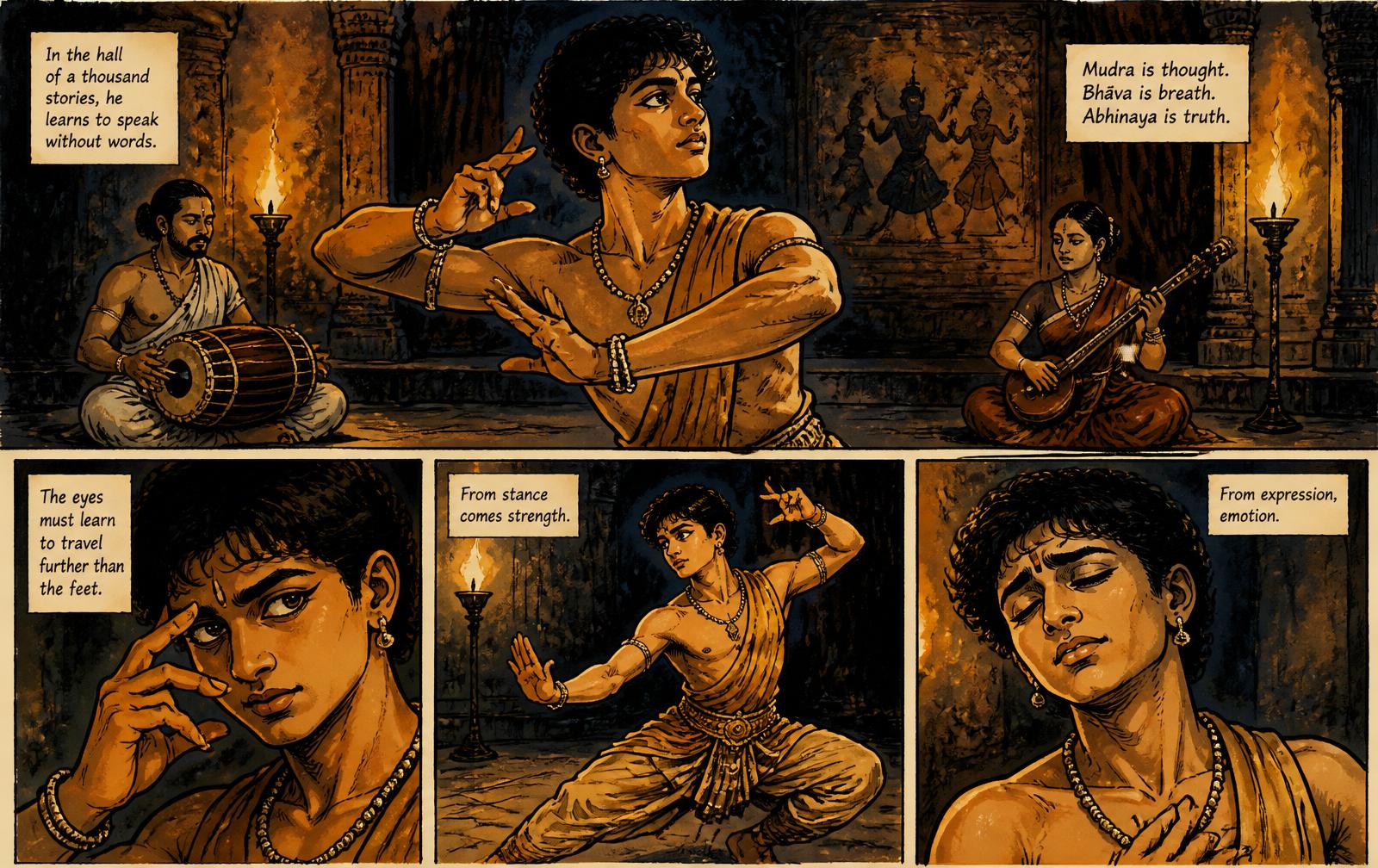
The Hall of a Thousand Stories
He arrives at sunset. The pillars are still warm from the day. Somewhere a drum is being tuned — not yet music, only the idea of it.
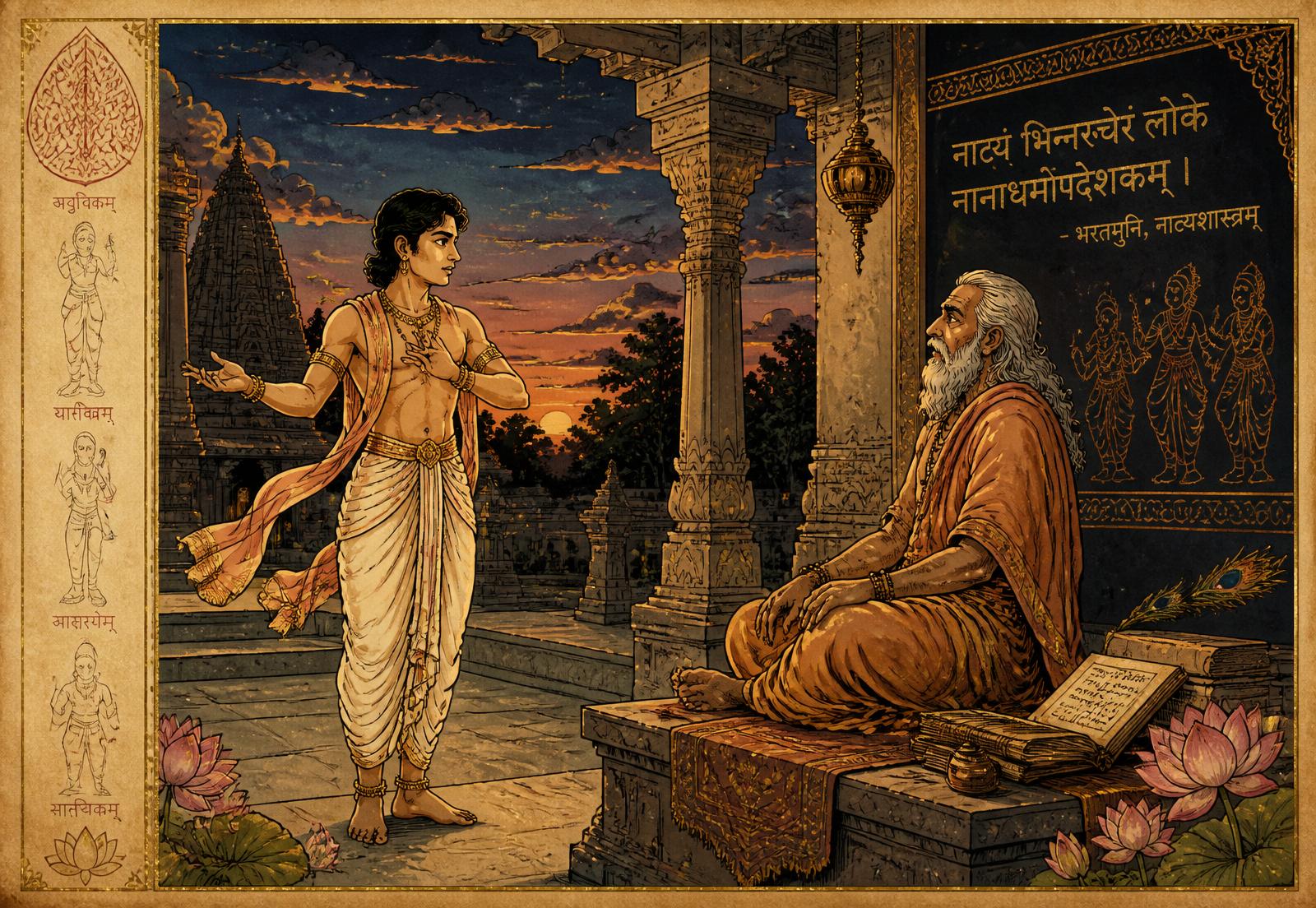
Bharata does not look up from the manuscript. "Why have you come?" the sage asks. The boy answers what he has rehearsed: to learn to act. The old man finally smiles. "Then you have learned the wrong word."
"We do not act. We make others feel."
Eyes Before Feet
For weeks he is not allowed to move. Only the eyes. Bharata teaches him the thirty-six glances — the sidelong, the trembling, the closed in grief, the half-closed in love.
"The body lies easily," the sage says. "The eyes cannot. If the eyes know nothing, the body will be a beautiful liar, and the audience will leave with nothing in their mouth."
He learns that abhinaya — expression — is the surface of a deeper word: bhāva, the inner state that the actor must first become.
The Nine Petals
On a night of the full moon Bharata draws the wheel in the dust. Nine petals around a center.
"This is what we are building," he says. "Not a story. A flavor. Śṛṅgāra for the lover, Vīra for the warrior, Karuṇa for the mourner, Hāsya for the fool — and at the heart, when all of them are still, Śānta."
The boy asks which is the highest. Bharata laughs. "You are asking the wrong question. Which spice is the highest? The one the dish requires."
The First Performance
Months later he plays a king who loses his beloved. He does not weep on stage — Bharata has forbidden it. "Your tears are yours," he was told. "You must leave the theatre dry, so the audience may leave wet."
When the play ends the audience is silent. Then an old woman in the back of the hall begins to cry. Not for the king. For her own husband, gone fifteen years.
Backstage, Bharata places one hand on his shoulder. "You see? You did not give her sorrow. You gave her the means to taste her own."
"That," the sage says, "is rasa."
समाप्तम्
It is complete.